Why Healthcare Remains the UK’s Most Resilient Career Path in 2026
The global economic landscape of 2026 is defined by volatility. From the rapid integration of generative AI in corporate sectors to the fluctuating stability of traditional finance, many industries are grappling with “job displacement anxiety.” However, in the United Kingdom, one sector stands as a bastion of stability: healthcare.
Despite technological shifts and fiscal challenges, the healthcare sector remains the largest employer in the UK and the most resilient career choice for new graduates and career-switchers alike. This resilience is not accidental; it is built on a foundation of demographic necessity, government commitment, and the irreplaceable nature of human-centric care.
The Demographic Driver: An Aging Population
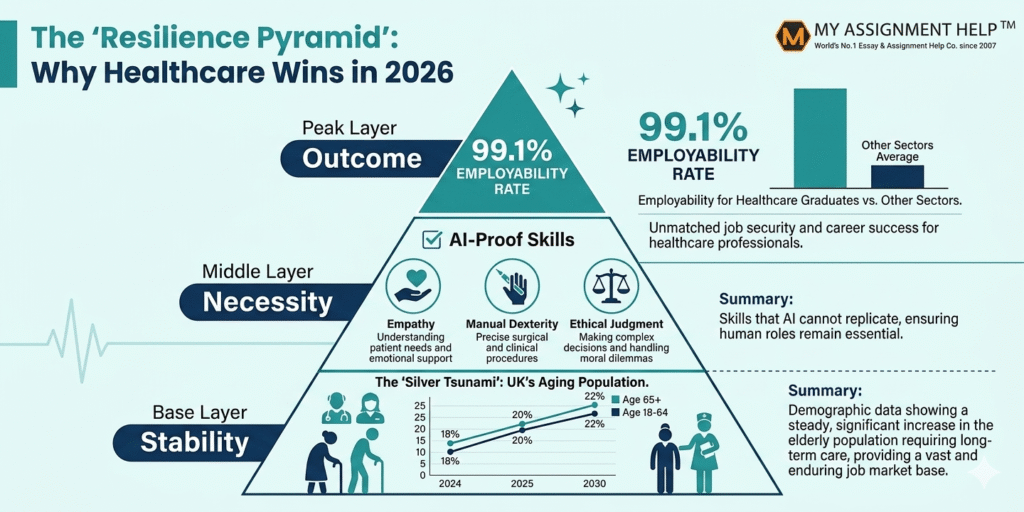
The primary catalyst for healthcare demand in 2026 is the UK’s demographic shift. According to the Office for National Statistics (ONS), the number of people aged 65 and over is growing significantly faster than those of working age. This “silver tsunami” has led to a sustained increase in chronic condition management, geriatric care, and complex surgical needs.
In 2026, the demand for registered nurses and specialized clinical practitioners has reached an all-time high. For students entering the field, this translates to nearly 100% employability post-graduation. Navigating the rigorous academic requirements of medical school or nursing programs can be intensive, and many students seek reliable academic support. Utilizing a trusted academic partner like myassignment help can provide the necessary guidance for complex coursework. For those specifically tackling the demanding clinical modules of a degree, seeking nursing assignment help uk ensures that future practitioners meet the high standards of the Nursing and Midwifery Council (NMC).
The “Human-in-the-Loop” Advantage: Why AI Won’t Replace Care
While 2026 has seen AI automate administrative tasks and enhance diagnostic accuracy, it has not replaced the healthcare professional. On the contrary, it has augmented their role. The UK’s healthcare strategy now emphasizes “Empathetic Technology”—where AI handles data-heavy tasks, allowing doctors and nurses more time for patient interaction.
A career in healthcare is inherently “AI-proof.” While an algorithm can analyze a scan, it cannot provide the emotional intelligence required for palliative care, the physical dexterity for emergency trauma surgery, or the moral judgment required in medical ethics. This human necessity keeps healthcare at the top of the resilience index.
Economic Stability and the NHS Long-Term Plan
The UK government’s continued investment in the NHS Long-Term Workforce Plan (updated for the 2025-2030 cycle) ensures a steady pipeline of roles. With billions of pounds allocated toward digital transformation and staff retention, healthcare professionals enjoy a level of job security that the private tech or retail sectors currently lack.
Furthermore, healthcare careers offer a “recession-proof” salary structure. While private-sector bonuses may vanish during a downturn, the structured pay scales of the NHS provide a predictable and ascending career trajectory. For international students or those relocating to the capital, securing a place in this sector is a priority. Professional assignment help london services assist students in mastering the localized curriculum requirements of top UK universities, ensuring they are career-ready upon graduation.
Diversification of Roles: Beyond the Ward
In 2026, a healthcare career doesn’t strictly mean working in a hospital. The “resilience” of the path also comes from its diversity. Emerging roles include:
- Telehealth Coordinators: Managing the 30% of UK consultations now happening via remote monitoring.
- Bio-Informatics Specialists: Bridging the gap between data science and clinical application.
- Community Wellbeing Leads: Focusing on preventative care and mental health at a local level.
Key Takeaways
- Job Security: Healthcare currently has the lowest unemployment rate of any UK sector in 2026.
- AI Integration: Technology is augmenting, not replacing, healthcare roles, focusing on “Human-in-the-Loop” care.
- Demographic Demand: An aging UK population ensures that healthcare needs will continue to grow for the next three decades.
- Educational Support: The academic path is rigorous, but specialized support services are available to help students navigate the high standards of UK medical education.
The Skill-to-Salary Bridge: Healthcare ROI 2026
Data from the 2025 UK Labour Market Report indicates that healthcare graduates see a faster return on investment (ROI) for their tuition fees compared to humanities or general business graduates. The availability of “Earn while you Learn” apprenticeships in nursing and allied health professions has further solidified healthcare as a financially prudent choice.
Frequently Asked Questions (FAQ)
Q: Is healthcare still a good career choice with the rise of AI?
A: Absolutely. AI is being used as a tool to reduce paperwork, but the core of healthcare—diagnosis, empathy, and physical intervention—remains a human-centric requirement that technology cannot replicate.
Q: What is the most in-demand healthcare role in the UK for 2026?
A: Mental health nursing and geriatric care specialists currently see the highest vacancy rates and the most competitive starting salaries.
Q: How difficult is the academic path for healthcare in the UK?
A: It is rigorous and highly regulated. Students must demonstrate both theoretical knowledge and practical clinical competence. Many students utilize academic resources and professional tutoring to maintain their GPA and meet NMC or GMC standards.
Q: Are there healthcare opportunities outside of London?
A: Yes. The NHS Long-Term Plan specifically targets “cold spots” in the Midlands and North of England, often offering recruitment incentives for practitioners to relocate to these areas.
Author Bio: Dr. Aris Thorne
Senior Academic Strategist at MyAssignmentHelp Dr. Aris Thorne holds a PhD in Healthcare Administration and has over 15 years of experience in the UK higher education sector. Currently serving as a lead consultant at MyAssignmentHelp, Dr. Thorne specializes in curriculum development and SEO-driven content strategy for medical and nursing education. His work focuses on the intersection of E-E-A-T principles and clinical excellence, helping students across the UK, US, and Australia achieve their professional milestones.
References and Data Sources
- Office for National Statistics (ONS) 2026: Projected Ageing Populations and Healthcare Demand Reports.
- NHS England: NHS Long-Term Workforce Plan: 2025-2030 Update.
- The Lancet Digital Health: The Role of Empathetic AI in Modern Clinical Practice (January 2026).
- UK Department for Education: Graduate Outcomes and ROI by Sector 2025.
- HESA (Higher Education Statistics Agency): Enrollment Trends in Medical and Allied Health Subjects.